

A client comes to you for work; you take on the job, and now the work is done, and then the client sends you a message asking for your invoice, and you begin to panic. Now there are a lot of questions occupying your mind: Can I send an invoice without a company in Nigeria, or do I need a CAC certificate first? In most cases, yes, you can.
In this article, we are going to cover what clients actually check before paying, when TIN matters, and when registering with CAC starts to pay off.
Can You Send an Invoice Without CAC Registration?
Yes. An individual can invoice a client in Nigeria without being registered with the Corporate Affairs Commission (CAC). An invoice is simply a payment request. It says who did the work, what the work was, and what is owed.
CAC registration is a separate business decision. It isn’t a step you have to finish before you’re allowed to get paid.
There is one catch. Under the Companies and Allied Matters Act 2020, anyone trading under a name other than their own full personal name must register that name. So invoicing as “Ada Okafor” is fine. Invoicing as “Ada Designs” makes it a business name, and you should register it first before you use it.
Also, never put a CAC or RC number on an invoice if you don’t have one, and don’t invent a company name to look bigger. Finance teams can check, and a made-up detail damages trust far more than having no registration ever will.
What Nigerian Clients Check Before Paying
There are almost no finance teams that ask you whether you are registered or not. What they check is whether the invoice is clear enough to pay without having to ask any further questions. An invoice that is created by anyone without a registered business in Nigeria looks almost the same as any other invoice.
Here’s what a freelance invoice in Nigeria usually needs:
- Your correct name. It should match the name on your bank account. If the two differ, payment can get held up while someone asks questions.
- Contact details. A phone number and email, so the finance team can reach you.
- A clear invoice number. Something simple like INV-0001, then INV-0002.
- What you did. An itemised description, not just “services”.
- The amount. In naira, with the total clearly shown.
- Payment terms. A due date, such as 14 days from the invoice date.
- Bank details. Account name, bank and account number, or a payment link.
None of these depend on whether you have a CAC certificate or not.
A few habits also help you get paid faster. Send the invoice as a PDF, put the invoice number in your email subject, and keep a copy for your records. If the client uses a purchase order (a written go-ahead for the job), quote its number on the invoice too. This way you avoid delays.
When You Need a TIN and When You Do Not
A TIN is a Tax Identification Number. It’s a number that identifies you to the tax authority.
There were a few changes to the Nigerian Tax laws on the 1st of January 2026. The Federal Inland Revenue Service (FIRS) was renamed the Nigeria Revenue Service (NRS), and the old TINs were merged into a single “Tax ID”. Most people continue to call it TIN, so we will use that here so you don’t get confused.
Now the question that is being asked the most is: Do you need a TIN for an invoice in Nigeria? And the answer is that you do not need one to send an invoice. For individuals, your National Identification Number (NIN) now works as your Tax ID, so you do not need a company to have one.
When you do need a Tax ID is with tax. The new laws require everyone who earns income from a trade or a business to register with the tax authority. This is a tax matter that is separate from CAC registration and separate from whether your invoice is valid.
Some clients might ask for it, and it is only because some companies deduct withholding tax (WHT) from payments to service providers. This is an advance tax payment that the clients send to the government for you, after which they give you a credit note to use against your yearly tax. You will still invoice the full amount. Our guide on how Nigerian taxes affect your invoices explains the details.
This is in no way tax advice, and keep in mind that requirements can vary. For your own situation, check with the NRS or a tax professional.
When Registering With CAC Starts to Pay Off
Registration is a growth decision, not a starting requirement. These are signs that it is worth it:
- Your clients are getting bigger. Some larger companies prefer to contract a registered business rather than an individual, and repeat, higher-value work makes this more likely.
- You need a business bank account. Banks typically ask for a CAC certificate and a Tax ID to open one. A domiciliary account, which holds dollars or pounds, usually asks for the same.
- A client requires a registered vendor. Procurement forms at bigger firms often ask for a business account number.
- A payment provider hits you with a limit. Some, like Paystack’s Starter Business tier, cap how much an unregistered seller can collect in total.
A business name doesn’t create a separate legal entity, so you stay personally responsible for the business. A company is a separate legal entity, but it comes with more paperwork. Pick based on where you are now, and upgrade when the work grows.
Example Invoice for an Unregistered Business
Here’s a full worked example, using naira. Oghenetega is a developer who invoices under her own name.
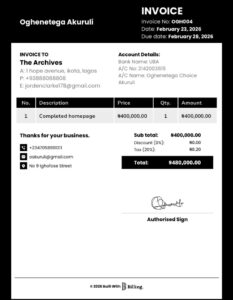
You can create invoices swiftly with Billing in seconds, with ease and zero complications.
Frequently Asked Questions
1. Do I need CAC registration to invoice a client in Nigeria?
No. You can invoice without CAC as an individual, using your own full name. If you want to trade under a business name, CAMA expects you to register that name.
2. Can I get a TIN without a registered business?
Yes. For individuals, your NIN works as your Tax ID, and you can retrieve it free on the NRS portal. If it doesn’t show up, the NRS can help you link it.
3. Will Nigerian companies pay an invoice from an unregistered individual?
Often, yes, as long as the invoice is clear and complete. Some larger companies only work with registered vendors. If a client asks for that, it’s a sign registration may be worth it.
4. When should I register my business with CAC?
When registration solves a real problem. That could be bigger clients asking for it, a bank wanting it for a business account, or a payment provider capping your collections. Until then, a clear invoice does the job.
Final thoughts
So, can you invoice without a registered business in Nigeria? Yes. Most Nigerian clients deal with unregistered freelancers and tradespeople all the time, and what gets you paid is a clear invoice, not a certificate.
Registration is a decision for later. Send the invoice now, and register when your work grows into it.