

Getting paid by a client in another country can sometimes feel more complicated than the work itself. Now you might be wondering how to invoice a foreign client. Well, the key to it is settling on the currency, payment method, tax treatment, and the exchange rate terms before you send the invoice to the client.
For freelancers and small business owners in Nigeria and Ghana, invoicing a client in USD, GBP, EUR, or any other foreign currency is possible, but every detail on the invoice must be clear to avoid any delays. And having a reliable way to receive the money once the client is ready to pay is necessary.
Which currency should the invoice be in?
The currency on your invoice must match the currency you and your client have agreed to use before the work started. If you’ve agreed to charge $1,200 for a project, your invoice should clearly show USD 1,200 instead of leaving the client to work out the conversion on their own.
For international clients, USD is common, but some might want to use GBP, EUR, CAD, or any other currency. With Billing, you can choose any currency you wish to invoice with, as the platform supports invoicing in over 100+ currencies.
The most important part of it all is consistency. Your contract, quotation, invoice, and payment instructions should all use the same agreed currency unless you and your client have agreed to change it.
If you’re billing in USD from Nigeria, for example, the invoice could show:
| Invoice detail | Ejemplo |
| Currency | USD |
| Project fee | $1,200 |
| Condiciones de pago | Due within 14 days |
| Método de pago | Transferencia bancaria |
| Amount due | $1,200 |
Don’t put a naira equivalent on the invoice unless there’s a specific reason to do so. If you include one, explain what exchange rate and date you used so the client doesn’t mistake it for the amount they need to pay.
What should you write about tax on a foreign invoice?
Tax treatment depends on which country is involved, the type of services or goods supplied, and your own tax position. There isn’t one tax rule that works for every foreign client invoice.
If you are a Nigerian freelancer, don’t automatically add Nigeria’s standard VAT rate simply because your client is overseas. Doing this will cause you expensive issues that will take longer to fix because whether or not VAT applies can depend on the nature of the transaction and the applicable tax rules.
Same as when a foreign client has withholding-tax requirements in their own country. If your client tells you that they have to deduct withholding tax, make sure to confirm how that tax deduction affects the amount you will actually receive and keep the relevant documentation properly. This way, you are not surprised by anything.
Your invoice can state the tax treatment clearly without trying to turn the invoice into a tax opinion. For example:
Tax: Not included. Any applicable withholding tax or deductions should be confirmed between the client and service provider before payment is made.
The statement above is only an example. The correct tax statement for your invoice should come from the applicable tax rules or a qualified tax professional
For Nigerian freelancers who need assistance in estimating their personal tax position, Billing’s Nigeria Tax Calculator provides an estimate based on the 2026 tax year. It is an estimation tool, not a tax filing service, so if you have a country-specific or transaction-specific question, you still need to seek advice from a professional who handles tax.
How can you receive dollars from a foreign client?
Creating the invoice is just half the process. You also need to agree on how the client will make payment.
Some of the available options to Nigerian freelancers and businesses include:
Domiciliary Account
A domiciliary account allows you to hold foreign currency through a Nigerian bank. If your client is paying by international bank transfer, ask your bank for the exact details the client needs, including the account information and any applicable SWIFT instructions.
Don’t copy payment details from another bank or even assume that every Nigerian bank uses the same instructions. Make sure to confirm the required details directly from your bank before sending them to your client.
Payoneer
This is another service used by most freelancers and businesses for cross-border payments. The availability, receiving account features, fees, and withdrawal options can vary by country and account type, so always check the current terms for your location before putting Payoneer details on any invoice.
Enlaces de pago
Payment links can give clients another way to pay without requiring you to exchange lengthy bank details over email.
Billing+ currently offers payment links as a Premium feature. Its payment features can be useful when your client prefers online payment rather than a direct bank transfer.
Whichever method you choose, make sure the payment method on your invoice is actually available to the client and to you before sending the invoice to avoid delays.
How should you handle exchange rates on an invoice?
Exchange rates are one of the easiest ways for an international payment to become confusing.
Suppose you charge $1,200 and the client agrees to pay you in USD. You don’t need to convert that amount into naira just to make the invoice look familiar. The client owes $1,200.
The naira amount you eventually receive can change depending on the exchange rate and the payment or conversion route used.
If you do need to show a naira equivalent, state the details clearly:
USD 1,200. Naira equivalent shown for reference only, based on the exchange rate applicable on the invoice date. Final naira value may vary based on the rate applied when funds are converted.
Don’t write a conversion rate on the invoice unless you know exactly why you’re using it.
You should also agree on who bears transaction or conversion fees. Otherwise, you could invoice $1,200 and receive less because a payment provider or intermediary bank deducted charges.
A clear payment note can help:
Amount to be received: USD 1,200. Any transaction or intermediary-bank charges are subject to the agreed payment arrangement.
The exact statement should match your agreement with the client.
What information should a foreign-client invoice include?
A foreign-client invoice should give the client enough information to identify the transaction and make the payment without having to email you for basic details.
So your invoice should include
- Your business address and contact details
- Your tax identification details where applicable
- Client’s legal name and billing details
- Número de factura único
- Fecha de la factura
- Fecha de vencimiento del pago
- Description of the service or product
- Quantity or hours, where relevant
- Unit price and total
- Currency
- Applicable taxes or tax notes
- Método de pago
- Payment account or payment-link details
- Condiciones de pago
- Exchange-rate or fee wording where relevant
The invoice should always match the information in your contract or the quotation that was agreed on.
How do you invoice a foreign client step by step?
Paso 1: Confirmar los detalles del cliente y del contrato
Antes de crear una factura, confirme el nombre legal del cliente, su dirección de facturación, la moneda preferida, sus obligaciones fiscales y la forma de pago. Estos datos deben coincidir con su contrato.
Paso 2: Elija la moneda correcta
Acuerde la moneda que utilizará para facturar al cliente por adelantado. Indíquelo claramente en la factura para evitar confusiones y disputas causadas por suposiciones sobre la conversión.
Paso 3: Determinar la aplicabilidad de los impuestos
Indique si se aplica IVA, GST o retención en la fuente, según los países involucrados. Si el impuesto está sujeto a inversión fiscal o exento, indíquelo claramente en la factura.
Paso 4: Crear una factura conforme
Incluya todos los elementos de factura internacionales necesarios para garantizar la precisión en los precios, los cálculos de impuestos y los métodos de pago.
Paso 5: Agregar condiciones de pago claras
Asegúrese de especificar las fechas límite de pago, los cargos por demora (si corresponde) y los métodos de pago aceptados. Para clientes internacionales, plazos de pago más cortos pueden ayudar a reducir los retrasos en el procesamiento.
Paso 6: Envíe la factura con prontitud
Envíe las facturas inmediatamente después de la prestación del servicio. Los retrasos aumentan el riesgo de pagos atrasados.
Paso 7: Seguimiento y control
Supervise siempre el estado de la factura y haga seguimiento profesional si se retrasa el pago; poner diferencias de zona horaria into consideration.
What does a USD invoice from a Nigerian freelancer look like?
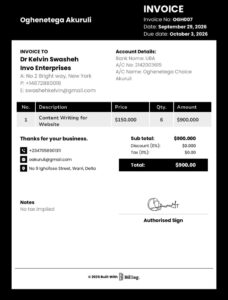
The freelancer could add a note such as:
Payment note: Please pay the full invoiced amount in USD. Any applicable bank or payment-provider charges should be handled according to the agreed payment terms.
Notice that the example doesn’t automatically add VAT or withholding tax. The correct tax treatment depends on the actual transaction and applicable rules.
For the same reason, don’t copy a tax note from another freelancer’s invoice just because they also work with foreign clients.
What are the best practices when invoicing foreign clients?
1. Agree on everything before work begins
Before you send a single invoice, make sure you and your client are on the same page about currency, payment method, tax responsibilities, and payment terms. Sorting this out upfront in writing means there are no surprises on either side when the invoice lands. It also gives you something to refer back to if a dispute comes up later.
2. Use a consistent invoice template every time
Switching up your invoice format from one client to the next creates confusion and looks unprofessional. A standard template that includes all the required details, your business name, TIN, client details, service description, currency, taxes, and payment information means nothing gets left out, and your clients always know what to expect when they receive a document from you.
3. Account for international fees in your pricing
Currency conversion fees, international transfer charges, and platform fees can quietly eat into what you actually receive. Factor these into your pricing from the start so that what you invoice is genuinely what you walk away with after all the deductions.
4. Keep detailed records for every transaction
For every international invoice you send, hold on to the invoice itself, the payment confirmation, any withholding tax certificates, and any exchange rate documentation. These records protect you during audits, help you file taxes accurately, and give you a clear picture of what clients owe and what has already been paid.
5. Automate where you can
Manually tracking invoices across multiple clients in different countries and currencies is the kind of work that leads to errors and missed follow-ups.
6. Make the payment instructions obvious
Your client shouldn’t have to search through an email thread to find where to send the money.
What common mistakes should you avoid?
There are a few mistakes that could cause back-and-forth between you and your client, which could lead to delayed payments:
- Sending an invoice without clearly stating the currency
- Using a different currency from the one agreed in the contract
- Assuming the same tax treatment applies to every foreign client
- Giving the client incorrect or incomplete bank details
- Forgetting to discuss payment and conversion fees
- Showing an exchange-rate conversion without stating the rate or date
- Leaving out the invoice due date
- Using payment methods that aren’t available in your country or the client’s country
- Treating an estimated tax calculation as a substitute for professional tax advice
The goal here is not to make the invoice look complicated; it is to make sure that your invoice is clear enough that there will be no need for follow-up questions from your client.
How can Billing Plus help?
If you invoice clients in different currencies, Billing+ lets you create invoices in 100+ currencies, including USD, GBP, and EUR. You can also manage your invoices and clients from the platform instead of creating every invoice from scratch.
If you’re looking for an invoice tool that supports multi-currency billing, you can explore Billing+ for Nigerian businesses and create your first invoice from the web or mobile app.
Free on iPhone, Android, and web. Make your first invoice in 10 seconds.
En resumen…
Invoicing foreign clients does not require many complications; it just needs more attention to detail and adherence to requirements. By understanding international tax obligations, choice of currencies, and compliance requirements, you can send invoices comfortably to your foreign clients.