

Your first client just said yes, the work is complete, and now you’re stuck staring at a blank page, trying to figure out how to send a freelance invoice without a company name. No registered business name, no fancy letterhead, it’s just you. This kind of uncertainty is normal, and it is not a real problem.
And it really isn’t. You don’t need to have a registered company to invoice as a freelancer; what you need to have is a complete, clear, and ready invoice. This guide walks through exactly what that should look like, how to actually get paid, and what changes if your client is in a different region.
Do Freelancers Need a Registered Company to Invoice?
No, you do not in most cases. Freelancing and business registration are two separate things. You can send invoices to clients and still get paid without ever having a registered business, and this is how a huge number of people bill their very first client. These clients aren’t checking whether or not you have a registered company; what they are checking for is whether the invoice itself is complete enough to process without any delay.
Having a registered business only starts to matter for tax purposes, not invoicing itself. As your income begins to grow, in most countries, you are expected to register, report earnings differently, and hit certain thresholds. This is a discussion you should have with a tax professional in your own region when it is time, but regardless, it doesn’t change the fact that you can invoice your clients now.
The 8 Things a Freelance Invoice Must Include
Every freelance invoice you create, regardless of the industry you are in, must include these 8 things;
- Your name and contact details. Your full name if you’re invoicing as an individual, plus how the client can reach you.
- Invoice number. A unique reference so both of you can point to this specific bill later.
- Date issued. When you sent it.
- Client details. Their name (or the company they work for) and contact information.
- Description of the work. Specific enough that there’s no confusion about what’s being billed. Break it into line items if you did more than one thing.
- Amount. The total, itemized if there’s more than one line.
- Due date. An actual date, not “soon.”
- Payment method. Exactly how you want to be paid.
Getting Paid: Bank Transfer, PayPal, Payment Link
How you get paid matters just as much as what is included in your invoice;
Bank transfer is the cheapest option, with little to no charges on both sides, and this payment method is more trusted for both local and international clients. The downside is that clients have to manually enter your details, which makes the entire payment process a bit more stressful compared to a one-click option.
PayPal is familiar to a lot of clients and quick to set up, which makes it a solid choice early on. It typically carries a processing fee, usually a percentage of the amount paid, which is worth factoring into your rates if you use it regularly.
A payment link attached to the invoice removes a step for the client: they click, pay, and you’re both done, without anyone typing in account numbers. It usually comes with a small transaction fee too, similar to PayPal, but the convenience often speeds up how fast you get paid.
There’s more detail on fees, speed, and which combination works best for different situations in our full breakdown of invoice payment methods.
Invoicing a Client Abroad
A lot of freelance work crosses borders, and invoicing a client abroad isn’t much different than invoicing a client in your region, but you need to pay attention to a few details.
Currency. Decide upfront whether you’re billing in your currency or theirs, and write it clearly using the three-letter code (USD, EUR, GBP) rather than just a symbol, since a “$” alone can mean several different currencies. This is usually the first thing you should make sure you confirm when invoicing an international client, since it affects everything else on the invoice.
Tax. Cross-border work sometimes involves tax rules that don’t come up domestically, such as a client withholding a percentage or requesting a form to confirm you’re a foreign supplier. This varies significantly by country on both ends. Always check before sending an invoice to international clients to prevent delays.
Getting paid. Bank transfer, PayPal, and payment links all still work internationally, though transfer speed and fees can vary more than they do domestically. Agreeing on the method and currency with your client before you start the work avoids surprises later.
Date formats. Something as small as writing 03/04/2026 can mean two different dates depending on where your client is based. Spelling the date out, like 4 March 2026, removes any ambiguity about when payment is actually due.
Free Freelance Invoice Template
Here’s a template you can copy directly, swapping in your own details:
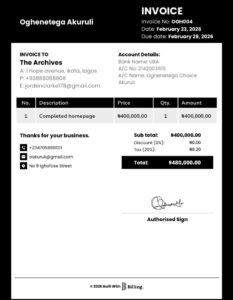
If you’d rather skip rebuilding this every time, Billing+ is free on iPhone, Android, y web, and lets you make your first invoice in about 10 seconds, no business name required.
Preguntas frecuentes
1. Can I invoice a client as a freelancer without a registered business?
Yes. You can invoice under your own name, and it’s how most freelancers bill their earliest clients. Having a registered business isn’t what makes an invoice valid; having a complete set of essential fields is what makes it valid.
2. What’s the minimum a freelance invoice needs to include?
Your name and contact details, an invoice number, the date, the client’s details, a description of the work, the amount, a due date, and your preferred payment method. Leaving any of these out will risk a delay while the client asks for what’s missing.
3. How do freelancers get paid internationally?
Bank transfer, PayPal, and payment links all work across borders, though fees and transfer times vary. Agreeing on currency and payment method with the client before the work starts is what prevents most of the friction.
4. Do I need to charge tax as an unregistered freelancer?
It depends on where you live and how much you’re earning; there’s no single answer that applies everywhere. Some countries expect freelancers to report and pay tax on income regardless of registration status, so it’s worth checking with a local tax professional rather than guessing.
Reflexiones finales
You don’t need to register a company to be paid professionally. A complete and clear invoice, an invoice with the right eight fields, a payment system that makes sense, and the right details if the client is overseas; that’s what actually determines if you’re getting paid. The business registration is optional. Clarity isn’t.